Why Did the Share Market Fall Today? 7 Big Macro Reasons Behind the 1,250-Point Sensex Crash
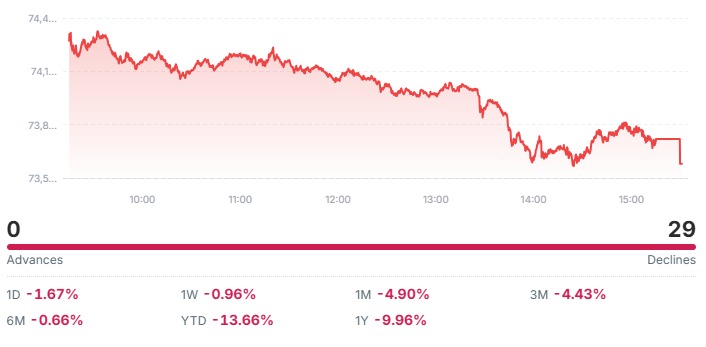
Domestic equities saw a sharp sell-off on September 24, 2026. The Sensex fell nearly 1,250 points to close at 73,580.54, while the Nifty dropped 383.70 points, or 1.64%, to end at 23,063.10. The weakness spread across the board, but financial stocks — banks, NBFCs, and insurance-linked names in particular — bore the heaviest brunt. So what dragged the market down so sharply in a single session? Several factors were at play at once.
1. US Bond Yields at Their Highest Since 2007
Stronger-than-expected business activity data out of the US signalled to markets that the Federal Reserve could keep policy tight for longer. As a result, the 10-year US Treasury yield climbed to around 5.11-5.12% — its highest level since 2007. That's bad news for emerging markets like India, since higher returns on US bonds strengthen the dollar and prompt foreign investors to pull money out of richly valued equity markets.
2. Brent Crude Above $102
Brent crude held around $102.5 a barrel after jumping nearly 4% in the previous session, with uncertainty over US-Iran tensions keeping prices elevated. Expensive crude is always bad news for India — it inflates the import bill and puts pressure on the current account and the rupee. Geojit Investments' V. K. Vijayakumar noted that Brent staying above $102 and the US 10-year yield touching 5.11% remain the biggest obstacles to any market recovery right now.
3. Weak Global Cues
Wall Street closed sharply lower in the previous session, and Asian markets followed suit — the MSCI Asia index fell around 0.4%, Hang Seng dropped about 0.5%, and the Shanghai Composite slipped roughly 0.4%. When US markets fall and yields rise, it's only natural for risk-sensitive markets like India's to come under selling pressure.
4. Profit-Booking After the Recent Rally
The Sensex had gained 299 points and the Nifty around 118 points on Wednesday. So as soon as global cues turned negative, traders moved to book profits. In other words, today's fall wasn't just panic-driven selling — it also reflected natural profit-taking after the recent run-up.
5. The Rupee Weakened Too
The rupee slipped 11 paise against the dollar to 95.84. Expensive crude, rising US yields, and a stronger dollar together weighed on the currency, raising the risk of imported inflation.
6. India VIX Jumps Nearly 10%
India VIX, often called the market's "fear gauge," surged nearly 10% to 11.33 — a sign that traders are bracing for more volatility ahead.
7. Heavy Selling in Banks, NBFCs and Insurers
The biggest domestic trigger behind today's fall was the financial sector. IRDAI's consultation paper has proposed changes to insurance commission and distribution rules — including a cap on commission payouts, linking commissions to product complexity, and spreading life-insurance commissions over several years instead of paying them upfront. These proposals raised concerns about earnings growth and margins for insurance distribution businesses, putting pressure on both insurers and bank-led distribution companies.
Why Financial Stocks Fell the Most
| Stock/Segment | Decline/Impact |
|---|---|
| Banks & Financials | Down nearly 2% |
| PB Fintech | Fell up to 23% |
| Turtlemint Fintech | Fell up to 23% |
| Axis Bank | Down around 3.5% |
| HDFC Bank | Down around 1.3% |
| NBFC stocks | Fell up to 4% |
According to Macquarie, the new IRDAI proposals could hit PB Fintech the hardest. Among banks, Axis Bank and HDFC Bank were said to have higher exposure to insurance distribution than ICICI Bank and Kotak Mahindra Bank. That pressure showed up clearly in the Bank Nifty, which fell 1,110 points, or 1.96%, to close at 55,438.50.
Which Sectors Fell the Most?
Barring pharma and realty, nearly all major Nifty sectoral indices were in the red during early trade. Broader markets weren't spared either — the Nifty Midcap 100 fell around 1.3% and the Smallcap 100 was down roughly 0.8%.
| Index | Closing Level | Change |
|---|---|---|
| Midcap Nifty | 14,040.30 | -3.65% |
| Bank Nifty | 55,438.50 | -1.96% |
| Sensex | 73,580.54 | -1.67% |
| Nifty | 23,063.10 | -1.64% |
The Midcap Nifty saw the steepest fall at 3.65%, meaning selling in small and mid-sized companies was far sharper than in large-caps. Pharma and realty, on the other hand, held up comparatively well.
Which Stocks Bucked the Trend?
Bharat Dynamics rose about 1.4% after the Ministry of Defence awarded the company an order worth around ₹811 crore for anti-airfield weapons.
| Stock | Performance |
|---|---|
| Kaveri Seed Co | +10.29% |
| Raymond | +8.00% |
| Raymond Realty | +5.49% |
| NSE | +1.85% |
| Cipla | +1.16% |
| ONGC | +0.89% |
| Zydus | +0.87% |
| Bharat Dynamics | ~+1.4% |
Pharma stocks saw defensive buying, ONGC benefited from the rally in crude, and Bharat Dynamics was lifted by its defence order. The moves in Kaveri Seed, Raymond, and Raymond Realty appear to be driven by company-specific factors that would need separate verification.
The Bottom Line
Today's fall can be traced through a fairly clear chain of events: strong US data raised fears of a prolonged Fed tightening cycle, which pushed up US yields and the dollar, sent crude above $100, weakened the rupee, and ultimately triggered heavy selling in financial stocks that dragged the Sensex, Nifty, and Midcap indices sharply lower. This wasn't just a technical correction — global macro pressure, oil-driven inflation worries, a weak rupee, a spike in the VIX, and selling triggered by IRDAI's new proposals all came together at once.
What to Watch Next
In the days ahead, investors will be watching the direction of US bond yields and crude prices closely, since both were at the centre of today's decline. Greater clarity on IRDAI's proposed rules could either bring stability back to insurance and financial stocks or add further pressure. The rupee's movement and FII flows will also remain in focus.
Source: Moneycontrol
Disclaimer: This article is based on a Moneycontrol report and is for informational purposes only. It is not investment advice. Please consult a financial advisor before making any investment decisions.