
JAIPUR: On Thursday, September 10, 2026, the Indian rupee weakened further against the US dollar, sliding to 95.25, compared to Wednesday's close of 95.10. Over the past two trading sessions, the rupee has fallen by roughly 0.7 percent — a sharper drop than seen in recent weeks, especially since the currency had remained relatively stable despite earlier swings in crude oil prices. The session before that, the rupee had already slipped 34 paise to close at 95.08, with crude oil breaching the $100 mark around the same time. Taken together, the last few days paint a picture of a currency caught between a domestic oil-import squeeze and a broader wave of global risk aversion — two forces that, when they hit at the same time, tend to be far harder for the central bank to cushion than either one alone.
Key Reasons Behind the Fall
1. Rising Crude Oil Prices
Amid escalating tensions between the US and Iran and fears of disruption to oil supplies, Brent crude has stayed above $100 a barrel. This matters enormously for India, which imports a large share of the crude it consumes and settles almost all of that trade in US dollars. When oil gets more expensive, Indian refiners and oil-marketing companies need more dollars to buy the same volume of crude, which mechanically pushes up demand for the greenback in the domestic market. That extra demand shows up almost immediately in the exchange rate, because oil is one of India's single largest import items and moves in large, dollar-denominated chunks rather than gradually.
There is also a psychological dimension to this: currency traders watch oil prices as a leading indicator of how India's trade balance and current account deficit are likely to evolve over the coming months. A sustained rally above $100 a barrel raises expectations of a wider import bill, and markets often start pricing in that future pressure on the rupee well before the actual trade data is published.
2. Global Risk-Aversion Sentiment
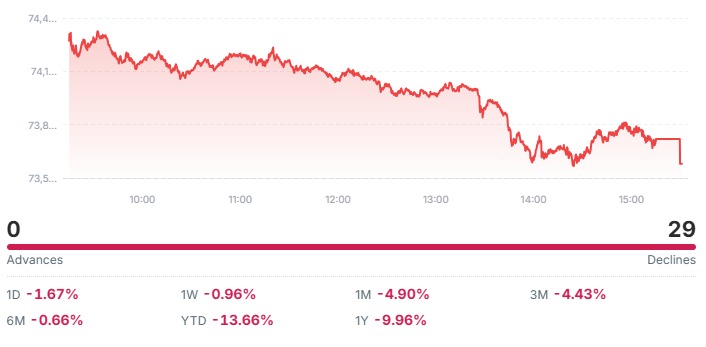
The US 10-year Treasury yield has climbed to its highest level since 2023. Rising US yields tend to make dollar-denominated assets more attractive relative to emerging-market currencies like the rupee, drawing global capital back toward the US and away from riskier markets. Combined with weakness in domestic equity markets and sustained selling by foreign investors, this has added further pressure on the currency. On Wednesday alone, foreign institutional investors (FIIs) sold Indian shares worth around ₹583 crore — and every rupee of that selling effectively needs to be converted back into dollars as it leaves the country, adding to the supply-demand imbalance already created by oil imports.
This kind of "risk-off" mood isn't unique to India. When global investors get nervous — whether about geopolitical tension, inflation, or interest-rate expectations — money typically flows out of emerging markets and into perceived safe havens like US Treasuries and the dollar itself. The rupee, like other emerging-market currencies, tends to bear the brunt of that shift even when the underlying Indian economy hasn't fundamentally changed.
3. A Stronger Dollar Index
The dollar index was trading at 98.84 on Wednesday, another major factor weighing on emerging-market currencies. The dollar index measures the greenback's strength against a basket of major currencies, so when it climbs, it isn't just the rupee that comes under pressure — most emerging-market currencies tend to weaken in tandem. That said, traders point out that the rupee has been depreciating somewhat faster than several of its regional peers, suggesting India-specific factors (chiefly the oil-import bill) are compounding the global dollar-strength story rather than simply riding along with it.
How Effective Is the RBI's Intervention?
The Reserve Bank of India (RBI) has been intervening continuously in the foreign exchange market to curb excessive volatility and slow the rupee's decline. In practice, this usually means the RBI selling dollars from its foreign exchange reserves to meet excess demand, which helps smooth out sharp, disorderly moves without necessarily reversing the underlying trend. Central banks generally use this kind of intervention not to fight the market indefinitely, but to prevent panic-driven spirals and give importers, exporters, and businesses time to adjust their hedging strategies.
However, market experts believe that as long as crude oil prices stay elevated, RBI's intervention can only slow the pace of the fall — it cannot fully offset the underlying pressure. Reserves are finite, and using them aggressively to defend a specific level of the currency can become costly if the pressure persists for weeks or months rather than days. That's why analysts often describe RBI's approach as "managing volatility" rather than "defending a level" — the central bank appears more focused on the speed of the decline than on holding the rupee at any particular number.
Analysts also note that the rupee's sensitivity to oil prices appears higher than that of some other Asian currencies, which haven't been as affected under similar conditions. This is partly structural: India imports a much larger share of its energy needs relative to the size of its economy compared with some of its regional peers, which makes the rupee more exposed to swings in global crude prices almost by design.
What Could Happen Next
If the rupee remains under pressure for an extended period, it could directly push up the cost of imported goods — not just fuel, but everything from edible oils to electronics components and raw materials priced in dollars — raising the risk of higher domestic inflation. A weaker rupee also makes overseas travel, foreign education, and dollar-denominated debt servicing more expensive for Indian households and companies. On the flip side, a cheaper rupee can offer some relief to India's exporters, whose goods become more price-competitive in international markets, though this benefit typically takes time to show up and can be offset if global demand itself is weak.
For now, the market is watching four key factors closely:
- The future trajectory of crude oil prices — particularly whether the US-Iran standoff escalates further or begins to cool off, and whether other oil producers step in to offset any supply disruption
- New developments in the US-Iran standoff — any diplomatic breakthrough or de-escalation could quickly ease the pressure on oil prices, and by extension, on the rupee
- Foreign fund inflows and outflows — whether FIIs continue pulling money out of Indian equities or start returning once valuations look more attractive
- The intensity of RBI's intervention in the currency market — how aggressively the central bank chooses to smooth out volatility in the days ahead, and how much of its reserves it is willing to deploy in the process
How these four factors play out together will determine the rupee's direction in the days ahead. A resolution on any one front — say, oil prices easing or foreign investors returning — could meaningfully change the currency's trajectory, while a worsening on multiple fronts simultaneously would likely test the limits of what RBI's intervention alone can achieve.